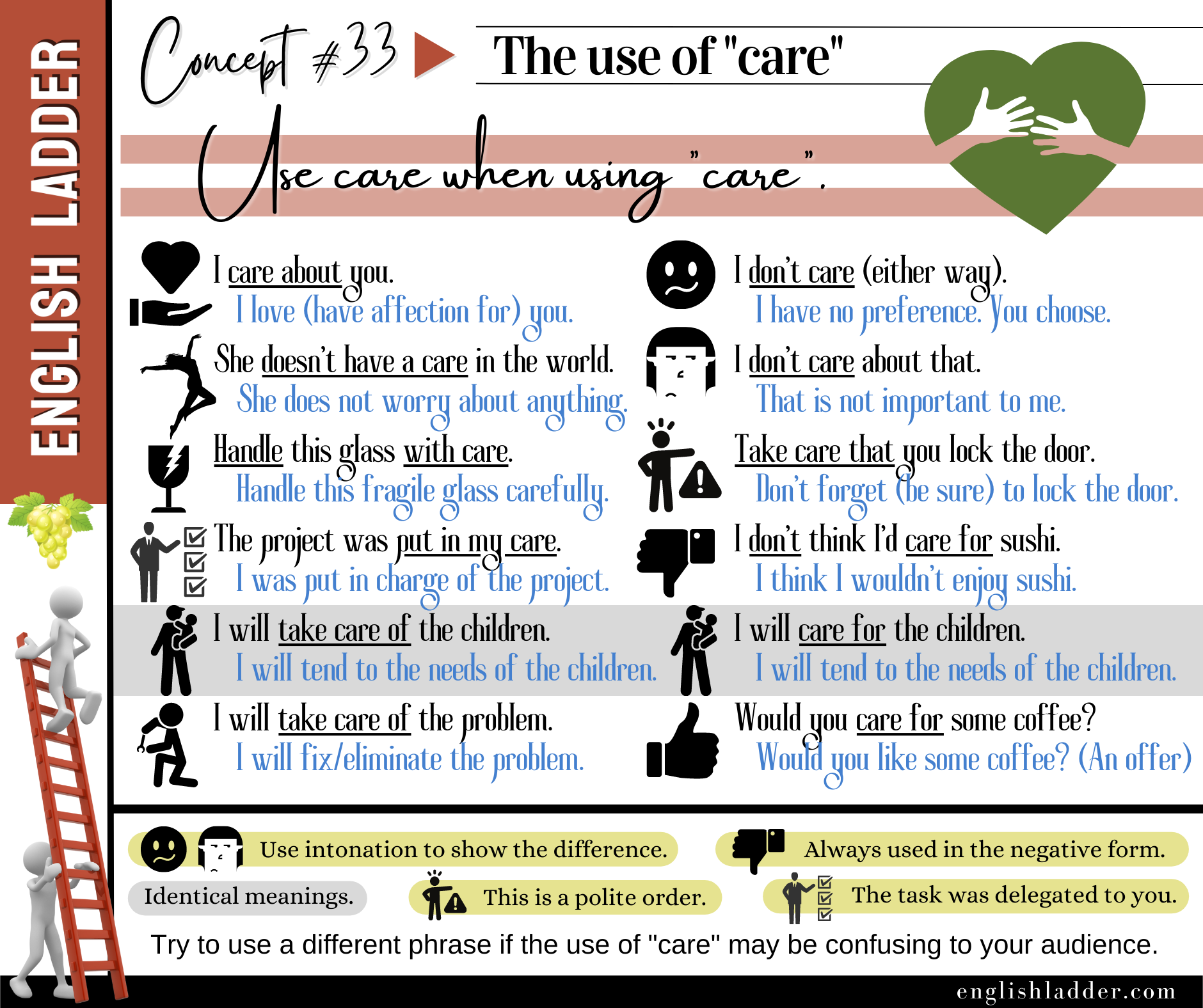
Grammar Concepts #33

The Use of “Care”

This rebuilt lesson keeps the original concept image, tightens the structure, and turns the explanation into a clearer self-study guide.

Core Idea

The word “care” is versatile, appearing in various contexts with slightly different meanings. Below are additional examples and edge cases to help solidify your understanding of how to use “care” effectively in English.

Key Points

1. Caring About Someone or Something

  • Example from the Image: “I care about you.”
  • Meaning: Expressing concern, affection, or interest.
  • Additional Examples: “I care about my community and volunteer regularly.” “They care deeply about preserving the environment.”
  • Edge Case: “Care about” vs. “Care for”: While both can express affection, “care for” often implies a deeper or more personal level of concern, often in caregiving situations. Example: “I care for my grandmother every weekend.” (Involves personal, hands-on care) Example: “I care about my grandmother.” (General concern or affection)

2. Having No Worries or Concerns

  • Example from the Image: “She doesn’t have a care in the world.”
  • Meaning: Being worry-free or unconcerned.
  • Additional Examples: “After winning the lottery, they felt like they didn’t have a care in the world.” “He’s so carefree, living life without a care.”
  • Edge Case: Literal vs. Figurative Use: The phrase is often used figuratively. Literally, everyone has some concerns, but this phrase emphasizes a moment of complete relaxation or freedom from worries. Example: “At the beach, I felt I didn’t have a care in the world.” (Figurative) Example: “She lives without a care in the world, never worrying about the future.” (Exaggeration for effect)

3. Handling Something Carefully

  • Example from the Image: “Handle this glass with care.”
  • Meaning: To handle something delicately or cautiously.
  • Additional Examples: “The museum staff handles the artifacts with great care.” “Handle these plants with care; they’re very fragile.”
  • Edge Case: Metaphorical Use: “With care” can also apply to non-physical actions, like how someone speaks or makes decisions. Example: “He chose his words with care to avoid offending anyone.” Example: “She handled the situation with care, ensuring everyone felt heard.”

4. Being in Charge of Something

  • Example from the Image: “The project was put in my care.”
  • Meaning: Being given responsibility for something or someone.
  • Additional Examples: “The children were left in the care of a trusted nanny.” “I was put in charge of the new marketing campaign.”
  • Edge Case: Temporary vs. Permanent Responsibility: “In my care” can indicate either a temporary or permanent responsibility. Example: “The dog is in my care while my friend is on vacation.” (Temporary) Example: “The orphanage took the child into its care.” (Permanent)

5. Taking Care of Someone or Something

  • Example from the Image: “I will take care of the children.”
  • Meaning: Looking after or managing the needs of someone or something.
  • Additional Examples: “Can you take care of this issue for me?” “He takes care of his health by exercising regularly.”
  • Edge Case: “Take care of” vs. “Care for”: “Take care of” often implies responsibility or a task, while “care for” can suggest a more nurturing or emotional involvement. Example: “She takes care of the household chores.” (Task-oriented) Example: “He cares for his sick mother.” (Nurturing, emotional)

6. Not Caring About Something

  • Example from the Image: “I don’t care (either way).”
  • Meaning: Indifference or lack of preference.
  • Additional Examples: “It’s your choice. I really don’t care.” “They don’t care what others think of them.”
  • Edge Case: Politeness and Tone: “I don’t care” can come across as rude if not softened by context or tone. It’s often better to use a more polite phrase in formal situations. Example: “I’m fine with whatever you decide.” (Polite) Example: “It doesn’t matter to me; you can choose.” (Neutral)

7. Taking Care to Ensure Something

  • Example from the Image: “Take care that you lock the door.”
  • Meaning: A polite reminder to ensure something is done carefully.
  • Additional Examples: “Take care that you don’t spill anything on the carpet.” “Please take care to arrive on time.”
  • Edge Case: Directive Nature: While “take care” is often polite, it can also carry an implied command, especially when addressing a potential mistake or oversight. Example: “Take care not to repeat this mistake.” (Implied warning) Example: “Take care when crossing the street.” (Reminder of caution)

8. Expressing a Preference

  • Example from the Image: “I don’t think I’d care for sushi.”
  • Meaning: Expressing a dislike or lack of preference.
  • Additional Examples: “Would you care for dessert?” (Offering politely) “She doesn’t care for spicy food.” (Expressing dislike)
  • Edge Case: Formal vs. Informal: “Care for” is more formal and polite, often used in offers or formal settings. Example: “Would you care for a drink?” (Formal offer) Example: “I don’t care for modern art.” (Expressing a mild dislike)

Common Phrasal Expressions with “Care”

  • Take care! (used as a farewell): “Take care! See you tomorrow.”
  • Care for (nurture or tend to): “She cared for him during his illness.”
  • Care about (show concern): “I care about what happens to the environment.”
  • Handle with care (treat carefully): “These boxes are fragile, so handle with care.”

Summary of Edge Cases and Special Considerations

  • “Care about” vs. “Care for”: Differentiate between general concern (care about) and personal, nurturing concern (care for).
  • Politeness in Negative Forms: “I don’t care” can sound rude; consider softer alternatives.
  • Temporary vs. Permanent Responsibility: The phrase “in my care” can imply different durations of responsibility.
  • Formal vs. Informal Usage: “Care for” is often more formal, especially in polite offers or refusals.

Understanding these nuances and edge cases will help you use the word “care” more accurately and effectively in various situations. Practicing with these examples and paying attention to context will further enhance your grasp of the different meanings and applications of “care.”

Practice Check

Answer the quiz questions below with responses consistent with the grammar concepts taught in this article.

Item 01

Which of the following sentences means “I am indifferent to the outcome”?

  • a) I care about the outcome.
  • b) I don’t care about the outcome.
  • c) I will take care of the outcome.
  • d) I care for the outcome.
Reveal answer

Correct answer

  • a) I care about the outcome.

Incorrect answers

  • b) I don’t care about the outcome.
  • c) I will take care of the outcome.
  • d) I care for the outcome.

Explanation: “I don’t care about the outcome” expresses indifference. The other options are incorrect because: **a)** Expresses concern. **c)** Implies responsibility. **d)** Suggests nurturing, not indifference.

Item 02

Which of the following sentences means “Please be careful with this fragile item”?

  • a) Handle this vase with care.
  • b) I will take care of the vase.
  • c) I care for this vase.
  • d) I don’t care about the vase.
Reveal answer

Correct answer

  • a) Handle this vase with care.

Incorrect answers

  • b) I will take care of the vase.
  • c) I care for this vase.
  • d) I don’t care about the vase.

Explanation: “Handle this vase with care” is a polite way of asking someone to be careful with a fragile item. The other options are incorrect because: **b)** Suggests responsibility for the vase, but not specifically about being careful. **c)** Indicates a nurturing attitude toward the vase, but not a request for caution. **d)** Expresses indifference, which is the opposite of being careful.

Item 03

Which of the following sentences means “I am concerned about environmental issues”?

  • a) I care about the environment.
  • b) I don’t care for environmental issues.
  • c) I will take care of the environment.
  • d) I care for the environment.
Reveal answer

Correct answer

  • a) I care about the environment.

Incorrect answers

  • b) I don’t care for environmental issues.
  • c) I will take care of the environment.
  • d) I care for the environment.

Explanation: “I care about the environment” directly expresses concern for environmental issues. The other options are incorrect because: **b)** Expresses a lack of concern. **c)** Indicates responsibility, but not necessarily concern. **d)** Suggests a nurturing role, which can imply concern, but is less direct than **a)**.

Item 04

Which of the following sentences means “I have no strong preference”?

  • a) I don’t care either way.
  • b) I care a lot about this decision.
  • c) I will take care of this decision.
  • d) I care deeply about this matter.
Reveal answer

Correct answer

  • a) I don’t care either way.

Incorrect answers

  • b) I care a lot about this decision.
  • c) I will take care of this decision.
  • d) I care deeply about this matter.

Explanation: “I don’t care either way” expresses indifference or a lack of strong preference. The other options are incorrect because: **b)** Indicates strong concern. **c)** Implies responsibility for making a decision, but not indifference. **d)** Indicates deep concern.

Item 05

Which of the following sentences means “I will manage this task”?

  • a) I will take care of this task.
  • b) I don’t care about this task.
  • c) I care for this task.
  • d) I will care this task.
Reveal answer

Correct answer

  • a) I will take care of this task.

Incorrect answers

  • b) I don’t care about this task.
  • c) I care for this task.
  • d) I will care this task.
  • Care for
  • Care this task

Explanation: “I will take care of this task” means you will manage or handle the task. The other options are incorrect because: **b)** Expresses indifference, not responsibility. **c)** “Care for” suggests nurturing, which is not typically applied to tasks. **d)** “Care this task” is grammatically incorrect.

Item 06

Which of the following sentences means “I am responsible for the project”?

  • a) I care about the project.
  • b) I care for the project.
  • c) The project is under my care.
  • d) I will care about the project.
Reveal answer

Correct answer

  • a) I care about the project.

Incorrect answers

  • b) I care for the project.
  • c) The project is under my care.
  • d) I will care about the project.

Explanation: “The project is under my care” indicates responsibility. The other options are incorrect because: **a)** Expresses concern, not responsibility. **b)** Suggests a nurturing attitude, not necessarily responsibility. **d)** Expresses concern, but in a future sense and is less direct.

Item 07

Which of the following sentences means “I don’t worry about anything”?

  • a) I take care of everything.
  • b) I don’t care for worrying.
  • c) I don’t have a care in the world.
  • d) I care about worrying.
Reveal answer

Correct answer

  • a) I take care of everything.

Incorrect answers

  • b) I don’t care for worrying.
  • c) I don’t have a care in the world.
  • d) I care about worrying.

Explanation: “I don’t have a care in the world” means you don’t worry about anything. The other options are incorrect because: **a)** Suggests responsibility, not a lack of worry. **b)** Expresses a dislike for worrying but doesn’t mean the absence of worry. **d)** Is contradictory and doesn’t make sense in this context.

Item 08

Which of the following sentences means “I will make sure to do this”?

  • a) I care about doing this.
  • b) I will take care to do this.
  • c) I don’t care about doing this.
  • d) I care for doing this.
Reveal answer

Correct answer

  • a) I care about doing this.

Incorrect answers

  • b) I will take care to do this.
  • c) I don’t care about doing this.
  • d) I care for doing this.
  • care for doing

Explanation: “I will take care to do this” implies that you will ensure it gets done. The other options are incorrect because: **a)** Expresses concern, but not the same level of commitment. **c)** Expresses indifference, not commitment. **d)** Is an incorrect construction; “care for doing” is not grammatically correct.

Item 09

Which of the following sentences means “I dislike this type of food”?

  • a) I care for spicy food.
  • b) I don’t care for spicy food.
  • c) I care about spicy food.
  • d) I take care of spicy food.
Reveal answer

Correct answer

  • c) I care about spicy food.

Incorrect answers

  • a) I care for spicy food.
  • b) I don’t care for spicy food.
  • d) I take care of spicy food.

Explanation: “I don’t care for spicy food” is a polite way to say you dislike it. The other options are incorrect because: **a)** Implies that you like or appreciate spicy food. **c)** Expresses concern or interest, not dislike. **d)** Implies responsibility, which doesn’t apply to food preferences.

Item 10

Which of the following sentences means “I will ensure this is done correctly”?

  • a) I care for doing this task.
  • b) I don’t care about doing this task.
  • c) I will take care to do this task correctly.
  • d) I will care about doing this task.
Reveal answer

Correct answer

  • a) I care for doing this task.

Incorrect answers

  • b) I don’t care about doing this task.
  • c) I will take care to do this task correctly.
  • d) I will care about doing this task.

Explanation: “I will take care to do this task correctly” implies that you will ensure it is done properly. The other options are incorrect because: **a)** Is incorrect as “care for doing” doesn’t express the same meaning. **b)** Expresses indifference, not responsibility. **d)** Expresses concern but lacks the sense of responsibility.

Item 11

Which of the following sentences means “I love you”?

  • a) I care about you.
  • b) I don’t care about you.
  • c) I will care for you.
  • d) I will take care of you.
Reveal answer

Correct answer

  • a) I care about you.

Incorrect answers

  • b) I don’t care about you.
  • c) I will care for you.
  • d) I will take care of you.

Explanation: “I care about you” can express love or deep affection. The other options are incorrect because: **b)** Expresses indifference. **c)** Suggests a future sense of nurturing or looking after. **d)** Implies responsibility, not necessarily love.

Item 12

Which of the following sentences means “I don’t prefer tea”?

  • a) I don’t care for tea.
  • b) I care about tea.
  • c) I take care of tea.
  • d) I don’t care about tea.
Reveal answer

Correct answer

  • a) I don’t care for tea.

Incorrect answers

  • b) I care about tea.
  • c) I take care of tea.
  • d) I don’t care about tea.

Explanation: “I don’t care for tea” is a polite way of saying you don’t prefer tea. The other options are incorrect because: **b)** Expresses concern or interest, not dislike. **c)** Implies responsibility, which doesn’t apply to preferences. **d)** Expresses indifference, not a lack of preference.

Item 13

Which of the following sentences means “I will handle this problem”?

  • a) I care for this problem.
  • b) I don’t care about this problem.
  • c) I will take care of this problem.
  • d) I care about this problem.
Reveal answer

Correct answer

  • a) I care for this problem.

Incorrect answers

  • b) I don’t care about this problem.
  • c) I will take care of this problem.
  • d) I care about this problem.

Explanation: “I will take care of this problem” means you will handle or manage it. The other options are incorrect because: **a)** “Care for” suggests nurturing, not problem-solving. **b)** Expresses indifference. **d)** Expresses concern, but not necessarily action.

Item 14

Which of the following sentences means “I don’t care about the decision”?

  • a) I care for the decision.
  • b) I don’t care about the decision.
  • c) I will take care of the decision.
  • d) I care about the decision.
Reveal answer

Correct answer

  • b) I don’t care about the decision.

Incorrect answers

  • a) I care for the decision.
  • c) I will take care of the decision.
  • d) I care about the decision.

Explanation: “I don’t care about the decision” expresses indifference. The other options are incorrect because: **a)** Suggests nurturing, not indifference. **c)** Implies responsibility, not indifference. **d)** Expresses concern, not indifference.

Item 15

Which of the following sentences means “I have no concerns or worries”?

  • a) I will take care of the worries.
  • b) I don’t care for concerns.
  • c) I don’t have a care in the world.
  • d) I care about having concerns.
Reveal answer

Correct answer

  • a) I will take care of the worries.

Incorrect answers

  • b) I don’t care for concerns.
  • c) I don’t have a care in the world.
  • d) I care about having concerns.

Explanation: “I don’t have a care in the world” means you have no worries. The other options are incorrect because: **a)** Suggests handling worries, not the absence of them. **b)** Expresses a dislike for concerns, not their absence. **d)** Is contradictory and incorrect.

Item 16

Which of the following sentences means “I am not interested in this topic”?

  • a) I care about this topic.
  • b) I care for this topic.
  • c) I don’t care about this topic.
  • d) I will take care of this topic.
Reveal answer

Correct answer

  • a) I care about this topic.

Incorrect answers

  • b) I care for this topic.
  • c) I don’t care about this topic.
  • d) I will take care of this topic.

Explanation: “I don’t care about this topic” expresses a lack of interest. The other options are incorrect because: **a)** Expresses concern or interest. **b)** Suggests a nurturing attitude, not a lack of interest. **d)** Implies responsibility, not disinterest.

Item 17

Which of the following sentences means “I am worried about the situation”?

  • a) I don’t care about the situation.
  • b) I care about the situation.
  • c) I will take care of the situation.
  • d) I care for the situation.
Reveal answer

Correct answer

  • a) I don’t care about the situation.

Incorrect answers

  • b) I care about the situation.
  • c) I will take care of the situation.
  • d) I care for the situation.

Explanation: “I care about the situation” expresses concern or worry. The other options are incorrect because: **a)** Expresses indifference, not worry. **c)** Implies responsibility, not necessarily concern. **d)** Suggests nurturing, which isn’t the same as worrying.

Item 18

Which of the following sentences means “I will ensure that the details are handled properly”?

  • a) I care about the details.
  • b) I will take care to handle the details properly.
  • c) I don’t care about the details.
  • d) I care for handling the details.
Reveal answer

Correct answer

  • a) I care about the details.

Incorrect answers

  • b) I will take care to handle the details properly.
  • c) I don’t care about the details.
  • d) I care for handling the details.

Explanation: “I will take care to handle the details properly” implies ensuring that the details are managed correctly. The other options are incorrect because: **a)** Expresses concern but not necessarily action. **c)** Expresses indifference, not responsibility. **d)** Is an awkward and incorrect construction.

Item 19

Which of the following sentences means “I am responsible for the children”?

  • a) I will care for the children.
  • b) I don’t care about the children.
  • c) The children are in my care.
  • d) I care about the children.
Reveal answer

Correct answer

  • a) I will care for the children.

Incorrect answers

  • b) I don’t care about the children.
  • c) The children are in my care.
  • d) I care about the children.

Explanation: “The children are in my care” means you are responsible for them. The other options are incorrect because: **a)** Suggests nurturing but doesn’t imply responsibility in the same way. **b)** Expresses indifference. **d)** Expresses concern, but not necessarily responsibility.

Item 20

Which of the following sentences means “I am not concerned about the issue”?

  • a) I care for the issue.
  • b) I care about the issue.
  • c) I don’t care about the issue.
  • d) I will take care of the issue.
Reveal answer

Correct answer

  • a) I care for the issue.

Incorrect answers

  • b) I care about the issue.
  • c) I don’t care about the issue.
  • d) I will take care of the issue.

Explanation: “I don’t care about the issue” expresses a lack of concern. The other options are incorrect because: **a)** Suggests nurturing, not indifference. **b)** Expresses concern. **d)** Implies responsibility.

Item 21

Which of the following sentences means “I will handle this delicately”?

  • a) I will care for this matter.
  • b) I don’t care about handling this.
  • c) I will take care to handle this delicately.
  • d) I care about handling this.
Reveal answer

Correct answer

  • a) I will care for this matter.

Incorrect answers

  • b) I don’t care about handling this.
  • c) I will take care to handle this delicately.
  • d) I care about handling this.

Explanation: “I will take care to handle this delicately” implies that you will manage the situation with caution. The other options are incorrect because: **a)** Suggests nurturing, but not the same level of caution. **b)** Expresses indifference. **d)** Expresses concern, but doesn’t specifically imply caution.

Item 22

Which of the following sentences means “I will look after the children”?

  • a) I will take care of the children.
  • b) I don’t care about the children.
  • c) I care for the children.
  • d) I care about the children.
Reveal answer

Correct answer

  • a) I will take care of the children.

Incorrect answers

  • b) I don’t care about the children.
  • c) I care for the children.
  • d) I care about the children.

Explanation: “I will take care of the children” means you will look after them. The other options are incorrect because: **b)** Expresses indifference. **c)** Suggests nurturing but not necessarily responsibility. **d)** Expresses concern, but not the action of looking after.

Item 23

Which of the following sentences means “I have no preference”?

  • a) I care for either option.
  • b) I don’t care either way.
  • c) I care about choosing.
  • d) I will take care of the choice.
Reveal answer

Correct answer

  • c) I care about choosing.

Incorrect answers

  • a) I care for either option.
  • b) I don’t care either way.
  • d) I will take care of the choice.

Explanation: “I don’t care either way” expresses a lack of preference. The other options are incorrect because: **a)** Implies a preference. **c)** Suggests concern, not indifference. **d)** Implies responsibility, not indifference.

Item 24

Which of the following sentences means “I will make sure to lock the door”?

  • a) I will take care to lock the door.
  • b) I don’t care about locking the door.
  • c) I will care for locking the door.
  • d) I care about locking the door.
Reveal answer

Correct answer

  • a) I will take care to lock the door.

Incorrect answers

  • b) I don’t care about locking the door.
  • c) I will care for locking the door.
  • d) I care about locking the door.

Explanation: “I will take care to lock the door” implies ensuring that the door will be locked. The other options are incorrect because: **b)** Expresses indifference. **c)** Is an incorrect construction. **d)** Expresses concern, but not necessarily action.