Grammar Concepts #20

Grammar Concepts #20

This rebuilt lesson keeps the original concept image, tightens the structure, and turns the explanation into a clearer self-study guide.

Core Idea

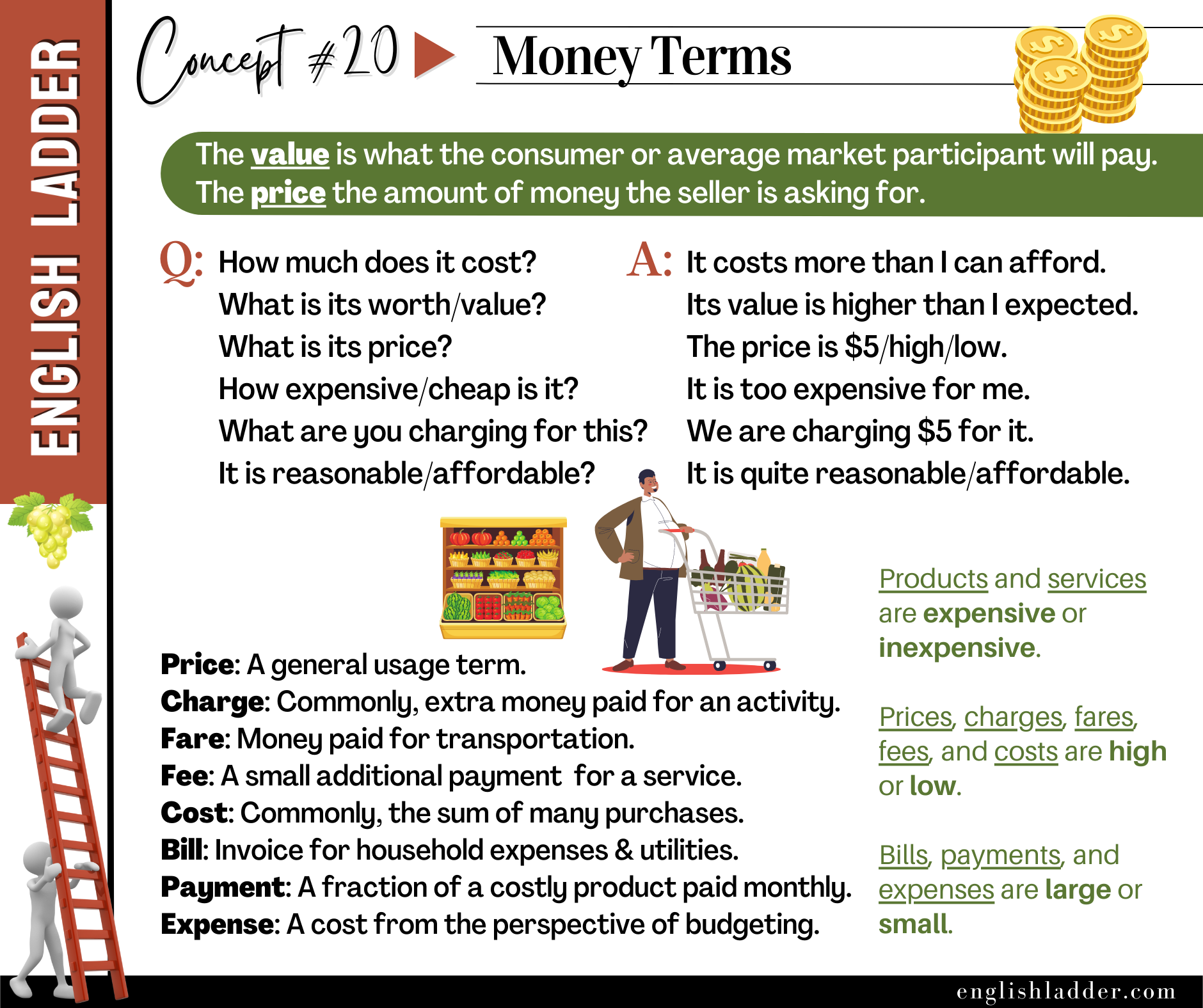
The image shows several question formats used to inquire about cost:

Key Points

1. Asking Questions About Price and Value

  • “How much does it cost?”
  • “What is its worth/value?”
  • “What is its price?”
  • “How expensive/cheap is it?”
  • “What are you charging for this?”
  • “Is it reasonable/affordable?”

These questions use different interrogative structures:

Used with adjectives like “much,” “expensive,” or “cheap” Example: “How expensive is that new smartphone?”

Used to ask about specific attributes like worth, value, or price Example: “What is the value of this antique watch?”

Begin with “Is” or “Are” to ask about qualities like reasonableness or affordability Example: “Is this apartment affordable for a student?”

2. Responding to Price Inquiries

The image provides several example responses:

  • “It costs more than I can afford.”
  • “Its value is higher than I expected.”
  • “The price is $5/high/low.”
  • “It is too expensive for me.”
  • “We are charging $5 for it.”
  • “It is quite reasonable/affordable.”

These responses demonstrate various grammatical structures:

Using “more than” or “higher than” to compare prices or values Example: “The concert tickets cost more than we budgeted for.”

Expressing that something exceeds a desirable or acceptable level Example: “This restaurant is too expensive for our group dinner.”

Using “are charging” to indicate an ongoing price or fee Example: “They are charging $50 per hour for tutoring services.”

Modifying adjectives like “reasonable” or “affordable” Example: “The new café’s prices are quite reasonable for the quality of food they serve.”

3. Vocabulary Distinctions

The image defines several related terms:

  • Price: A general usage term
  • Charge: Commonly, extra money paid for an activity
  • Fare: Money paid for transportation
  • Fee: A small additional payment for a service
  • Cost: Commonly, the sum of many purchases
  • Bill: Invoice for household expenses & utilities
  • Payment: A fraction of a costly product paid monthly
  • Expense: A cost from the perspective of budgeting

When using these terms, pay attention to their specific contexts:

Example sentences:

  • “The price of the shirt was $25.”
  • “There’s an additional charge of $10 for gift wrapping.”
  • “The bus fare from the airport to downtown is $15.”
  • “Our bank charges a monthly fee of $5 for the checking account.”
  • “The total cost of the home renovation project exceeded our budget.”
  • “Don’t forget to pay the electricity bill by the end of the month.”
  • “The car payments are $300 per month for the next five years.”
  • “We need to reduce our monthly expenses to save more money.”

4. Adjectives for Describing Prices and Products

The image mentions that products and services can be “expensive” or “inexpensive,” and that prices, charges, fares, fees, and costs can be “high” or “low.” Bills, payments, and expenses can be “large” or “small.”

Example sentences:

  • “Organic produce is often more expensive than conventional options.”
  • “Public transportation is usually an inexpensive way to travel around the city.”
  • “Hotel rates are high during the peak tourist season.”
  • “The entrance fee to the museum is quite low for students.”
  • “Our electricity bills are typically larger in winter due to heating costs.”

Remember that when using these adjectives, you can create comparative and superlative forms:

  • Expensive – more expensive – most expensive
  • High – higher – highest
  • Low – lower – lowest

Example: “Among all the restaurants we visited, this one had the most expensive menu but the lowest service charges.”

By understanding and practicing these terms and structures, non-native English speakers can become more comfortable discussing money-related topics in various contexts.

Bonus Section:

Money & Financial Terms: Advanced Information

  • Price vs. Cost: Price: The amount of money required to purchase something. Example: The price of the book is $20. Cost: The total amount of money spent on acquiring, producing, or maintaining something. Example: The cost of repairing the car was higher than expected.
  • Expense vs. Expenditure: Expense: A specific amount of money spent on something. Example: Her monthly expenses include rent, utilities, and groceries. Expenditure: The action of spending funds, often referring to larger amounts or over a period. Example: Government expenditures on infrastructure are increasing.
  • Income vs. Revenue: Income: Money received, especially on a regular basis, for work or through investments. Example: His annual income is $50,000. Revenue: The total income generated by a company or organization. Example: The company’s revenue increased by 10% last year.
  • Profit vs. Gain: Profit: The financial benefit when the revenue from business activities exceeds the expenses, costs, and taxes. Example: The company made a profit of $2 million. Gain: An increase in wealth or resources, which can be financial or non-financial. Example: He had a significant gain in his stock investments.

Examples in Sentences:

  • The price of the new laptop is quite high.
  • The cost of living in the city is rising.
  • She tracks her daily expenses carefully.
  • Government expenditure on healthcare is essential.
  • His primary source of income is his job.
  • The company’s revenue exceeded expectations.
  • They made a profit after selling the old house.
  • There was a substantial gain in the value of their property.

Note the differences and specific contexts in which these terms are used.

Practice Check

Answer the quiz questions below with responses consistent with the grammar concepts taught on the left.

Item 01

Which question is best for inquiring about the cost of a laptop?

  • A) How much does this laptop cost?
  • B) How is the price of this laptop?
  • C) Is this laptop expensive?
  • D) Does this laptop cost a lot?
Reveal answer

Correct answer

  • A) How much does this laptop cost?

Incorrect answers

  • B) How is the price of this laptop?
  • C) Is this laptop expensive?
  • D) Does this laptop cost a lot?

Explanation: This question uses “How much” which is the most appropriate way to ask about price or cost.

Item 02

Which sentence correctly compares the price of a phone to someone’s budget?

  • A) The new phone costs more than I can afford.
  • B) The new phone costs expensive than I can afford.
  • C) The new phone costs as I can afford.
  • D) The new phone costs how I can afford.
Reveal answer

Correct answer

  • A) The new phone costs more than I can afford.

Incorrect answers

  • B) The new phone costs expensive than I can afford.
  • C) The new phone costs as I can afford.
  • D) The new phone costs how I can afford.

Explanation: This sentence correctly uses “more than” to make a comparison.

Item 03

Which sentence best expresses that a car’s price exceeds someone’s budget?

  • A) This car is very expensive for me.
  • B) This car is too expensive for me.
  • C) This car is so expensive for me.
  • D) This car is much expensive for me.
Reveal answer

Correct answer

  • B

Incorrect answers

  • A) This car is very expensive for me.
  • B) This car is too expensive for me.
  • C) This car is so expensive for me.
  • D) This car is much expensive for me.
  • too expensive

Explanation: The phrase “too expensive” correctly expresses that the price exceeds an acceptable level.

Item 04

Which sentence correctly describes an ongoing pricing situation for concert tickets?

  • A) They charge $50 for the concert tickets.
  • B) They are charge $50 for the concert tickets.
  • C) They charging $50 for the concert tickets.
  • D) They are charging $50 for the concert tickets.
Reveal answer

Correct answer

  • D

Incorrect answers

  • A) They charge $50 for the concert tickets.
  • B) They are charge $50 for the concert tickets.
  • C) They charging $50 for the concert tickets.
  • D) They are charging $50 for the concert tickets.
  • are charging

Explanation: This sentence correctly uses “are charging” to describe an ongoing action.

Item 05

Which sentence best describes the prices at a new café?

  • A) The new café’s price is very reasonable.
  • B) The new café’s prices are quite reasonable.
  • C) The new café’s prices are much reasonable.
  • D) The new café’s prices are much reasonable.
Reveal answer

Correct answer

  • A) The new café’s price is very reasonable.

Incorrect answers

  • B) The new café’s prices are quite reasonable.
  • C) The new café’s prices are much reasonable.
  • quite

Explanation: This sentence correctly uses “quite” to modify the adjective “reasonable”.

Item 06

Which sentence correctly describes an additional cost for Wi-Fi at a hotel?

  • A) The hotel has an extra price for Wi-Fi.
  • B) The hotel has an extra fee for Wi-Fi.
  • C) The hotel has an extra charge for Wi-Fi.
  • D) The hotel has an extra cost for Wi-Fi.
Reveal answer

Correct answer

  • A) The hotel has an extra price for Wi-Fi.

Incorrect answers

  • B) The hotel has an extra fee for Wi-Fi.
  • C) The hotel has an extra charge for Wi-Fi.
  • D) The hotel has an extra cost for Wi-Fi.
  • charge

Explanation: This sentence correctly uses “charge” to describe an additional payment for a service.

Item 07

Which sentence correctly describes the cost of a bus trip to the airport?

  • A) The bus price to the airport is $15.
  • B) The bus fare to the airport is $15.
  • C) The bus fee to the airport is $15.
  • D) The bus cost to the airport is $15.
Reveal answer

Correct answer

  • A) The bus price to the airport is $15.

Incorrect answers

  • B) The bus fare to the airport is $15.
  • C) The bus fee to the airport is $15.
  • D) The bus cost to the airport is $15.
  • fare

Explanation: This sentence correctly uses “fare” to describe the cost of transportation.

Item 08

Which sentence correctly describes a recurring bank account cost?

  • A) The bank charges a monthly price of $5 for the account.
  • B) The bank charges a monthly payment of $5 for the account.
  • C) The bank charges a monthly fee of $5 for the account.
  • D) The bank charges a monthly bill of $5 for the account.
Reveal answer

Correct answer

  • A) The bank charges a monthly price of $5 for the account.

Incorrect answers

  • B) The bank charges a monthly payment of $5 for the account.
  • C) The bank charges a monthly fee of $5 for the account.
  • D) The bank charges a monthly bill of $5 for the account.
  • fee

Explanation: This sentence correctly uses “fee” to describe a regular payment for a service.

Item 09

Which sentence best describes the total expense of a home renovation project?

  • A) The total price of the home renovation exceeded our budget.
  • B) The total fee of the home renovation exceeded our budget.
  • C) The total charge of the home renovation exceeded our budget.
  • D) The total cost of the home renovation exceeded our budget.
Reveal answer

Correct answer

  • A) The total price of the home renovation exceeded our budget.

Incorrect answers

  • B) The total fee of the home renovation exceeded our budget.
  • C) The total charge of the home renovation exceeded our budget.
  • D) The total cost of the home renovation exceeded our budget.
  • cost

Explanation: This sentence correctly uses “cost” to refer to the total sum of expenses.

Item 10

Which sentence correctly reminds someone about a utility payment?

  • A) Don’t forget to pay the electricity price by the end of the month.
  • B) Don’t forget to pay the electricity bill by the end of the month.
  • C) Don’t forget to pay the electricity charge by the end of the month.
  • D) Don’t forget to pay the electricity fee by the end of the month.
Reveal answer

Correct answer

  • A) Don’t forget to pay the electricity price by the end of the month.

Incorrect answers

  • B) Don’t forget to pay the electricity bill by the end of the month.
  • C) Don’t forget to pay the electricity charge by the end of the month.
  • D) Don’t forget to pay the electricity fee by the end of the month.
  • bill

Explanation: This sentence correctly uses “bill” to refer to an invoice for household utilities.

Item 11

Which sentence correctly describes regular car financing installments?

  • A) The car costs are $300 per month for the next five years.
  • B) The car fees are $300 per month for the next five years.
  • C) The car charges are $300 per month for the next five years.
  • D) The car payments are $300 per month for the next five years.
Reveal answer

Correct answer

  • D

Incorrect answers

  • A) The car costs are $300 per month for the next five years.
  • B) The car fees are $300 per month for the next five years.
  • C) The car charges are $300 per month for the next five years.
  • D) The car payments are $300 per month for the next five years.
  • payments

Explanation: This sentence correctly uses “payments” to describe regular installments on a large purchase.

Item 12

Which sentence best describes reducing monthly outgoings to save money?

  • A) We need to reduce our monthly costs to save more money.
  • B) We need to reduce our monthly charges to save more money.
  • C) We need to reduce our monthly expenses to save more money.
  • D) We need to reduce our monthly fees to save more money.
Reveal answer

Correct answer

  • A) We need to reduce our monthly costs to save more money.

Incorrect answers

  • B) We need to reduce our monthly charges to save more money.
  • C) We need to reduce our monthly expenses to save more money.
  • D) We need to reduce our monthly fees to save more money.
  • expenses

Explanation: This sentence correctly uses “expenses” when discussing costs from a budgeting perspective.

Item 13

Which sentence correctly compares the price of organic produce to conventional options?

  • A) Organic produce is often more cost than conventional options.
  • B) Organic produce is often more price than conventional options.
  • C) Organic produce is often more expensive than conventional options.
  • D) Organic produce is often more payment than conventional options.
Reveal answer

Correct answer

  • A) Organic produce is often more cost than conventional options.

Incorrect answers

  • B) Organic produce is often more price than conventional options.
  • C) Organic produce is often more expensive than conventional options.
  • D) Organic produce is often more payment than conventional options.
  • expensive

Explanation: This sentence correctly uses “expensive” as an adjective to describe higher-priced items.

Item 14

Which sentence best describes public transportation as an economical option?

  • A) Public transportation is usually a budget way to travel around the city.
  • B) Public transportation is usually an inexpensive way to travel around the city.
  • C) Public transportation is usually a bargain way to travel around the city.
  • D) Public transportation is usually a discount way to travel around the city.
Reveal answer

Correct answer

  • A) Public transportation is usually a budget way to travel around the city.

Incorrect answers

  • B) Public transportation is usually an inexpensive way to travel around the city.
  • C) Public transportation is usually a bargain way to travel around the city.
  • D) Public transportation is usually a discount way to travel around the city.
  • inexpensive
  • bargain,
  • discount

Explanation: This sentence uses “inexpensive” to describe a service that doesn’t cost much. “Budget,” “bargain,” and “discount” are not as commonly used as adjectives in this context and sound less natural.

Item 15

Which sentence best describes increased hotel prices during peak season?

  • A) Hotel rates are expensive during the peak tourist season.
  • B) Hotel rates are costly during the peak tourist season.
  • C) Hotel rates are biggest during the peak tourist season.
  • D) Hotel rates are high during the peak tourist season.
Reveal answer

Correct answer

  • A) Hotel rates are expensive during the peak tourist season.

Incorrect answers

  • B) Hotel rates are costly during the peak tourist season.
  • C) Hotel rates are biggest during the peak tourist season.
  • D) Hotel rates are high during the peak tourist season.
  • high

Explanation: This sentence correctly uses “high” to describe elevated prices.

Item 16

Which sentence best describes reduced museum entry costs for students?

  • A) The entrance fee to the museum is quite cheaply for students.
  • B) The entrance fee to the museum is quite invaluable for students.
  • C) The entrance fee to the museum is quite low for students.
  • D) The entrance fee to the museum is quite very much for students.
Reveal answer

Correct answer

  • A) The entrance fee to the museum is quite cheaply for students.

Incorrect answers

  • B) The entrance fee to the museum is quite invaluable for students.
  • C) The entrance fee to the museum is quite low for students.
  • D) The entrance fee to the museum is quite very much for students.
  • low

Explanation: This sentence correctly uses “low” to describe a small fee.

Item 17

Which sentence best describes increased utility costs in winter?

  • A) Our electricity bills are typical bigger in winter due to heating costs.
  • B) Our electricity bills are typically larger in winter due to heating costs.
  • C) Our electricity bills are typically higher in winter maybe heating costs.
  • D) Our electricity bills are typically more big in winter due to heating costs.
Reveal answer

Correct answer

  • A) Our electricity bills are typical bigger in winter due to heating costs.

Incorrect answers

  • B) Our electricity bills are typically larger in winter due to heating costs.
  • C) Our electricity bills are typically higher in winter maybe heating costs.
  • D) Our electricity bills are typically more big in winter due to heating costs.
  • larger

Explanation: This sentence correctly uses “larger” to describe increased bills.

Item 18

Which sentence correctly compares restaurant prices?

  • A) Among all the restaurants we visited, this one had the most expensive menu but the low service charges.
  • B) Among all the restaurants we visited, this one had the expensivest menu but the lowest service charges.
  • C) Among all the restaurants we visited, this one had the most expensive menu but the lowest service charges.
  • D) Among all the restaurants we visited, this one had the more expensive menu but the more low service charges.
Reveal answer

Correct answer

  • A) Among all the restaurants we visited, this one had the most expensive menu but the low service charges.

Incorrect answers

  • B) Among all the restaurants we visited, this one had the expensivest menu but the lowest service charges.
  • C) Among all the restaurants we visited, this one had the most expensive menu but the lowest service charges.
  • D) Among all the restaurants we visited, this one had the more expensive menu but the more low service charges.
  • lowest

Explanation: This sentence correctly uses “most expensive” and “lowest” to make comparisons.

Item 19

Which question best asks if a price is fair?

  • A) Is this price logic?
  • B) Is this price sensible?
  • C) Is this price reasonable?
  • D) Is this price intelligent?
Reveal answer

Correct answer

  • A) Is this price logic?

Incorrect answers

  • B) Is this price sensible?
  • C) Is this price reasonable?
  • D) Is this price intelligent?
  • reasonable

Explanation: This question correctly uses “reasonable” to inquire about the fairness of a price.

Item 20

Which question best asks if a student can manage the cost of an apartment?

  • A) Is this apartment affordable for a student?
  • B) Is this apartment buyable for a student?
  • C) Is this apartment purchasable for a student?
  • D) Is this apartment obtainable for a student?
Reveal answer

Correct answer

  • A) Is this apartment affordable for a student?

Incorrect answers

  • B) Is this apartment buyable for a student?
  • C) Is this apartment purchasable for a student?
  • D) Is this apartment obtainable for a student?

Explanation: This question correctly uses “affordable” to ask if the apartment is within a student’s financial means.

Item 21

Which sentence correctly describes the current pricing for tutoring services?

  • A) They charge $50 per hour for tutoring services.
  • B) They charging $50 per hour for tutoring services.
  • C) They are charge $50 per hour for tutoring services.
  • D) They are charging $50 per hour for tutoring services.
Reveal answer

Correct answer

  • D

Incorrect answers

  • A) They charge $50 per hour for tutoring services.
  • B) They charging $50 per hour for tutoring services.
  • C) They are charge $50 per hour for tutoring services.
  • D) They are charging $50 per hour for tutoring services.
  • are charging

Explanation: This sentence correctly uses “are charging” to describe an ongoing action.

Item 22

Which question best asks about the price of an antique watch?

  • A) What is the cost of this antique watch?
  • B) How is the cost of this antique watch?
  • C) Where is the cost of this antique watch?
  • D) When is the cost of this antique watch?
Reveal answer

Correct answer

  • A) What is the cost of this antique watch?

Incorrect answers

  • B) How is the cost of this antique watch?
  • C) Where is the cost of this antique watch?
  • D) When is the cost of this antique watch?

Explanation: This question correctly uses “What” to inquire about the price or cost of an item.

Item 23

Which sentence best asks about the value of a painting?

  • A) How much is this painting worth?
  • B) What does this painting cost?
  • C) How expensive is this painting?
  • D) What price is this painting?
Reveal answer

Correct answer

  • A) How much is this painting worth?

Incorrect answers

  • B) What does this painting cost?
  • C) How expensive is this painting?
  • D) What price is this painting?

Explanation: This question correctly uses “worth” to inquire about the value of an item.

Item 24

Which sentence best describes a price reduction?

  • A) The store has lowered the cost of all summer clothing.
  • B) The store has decreased the price of all summer clothing.
  • C) The store has reduced the charge for all summer clothing.
  • D) The store has minimized the fee for all summer clothing.
Reveal answer

Correct answer

  • B

Incorrect answers

  • A) The store has lowered the cost of all summer clothing.
  • B) The store has decreased the price of all summer clothing.
  • C) The store has reduced the charge for all summer clothing.
  • D) The store has minimized the fee for all summer clothing.
  • decreased the price

Explanation: This sentence correctly uses “decreased the price” to describe a reduction in cost.